Mae govannen!
Welcome to the Mirror of Galadriel, a series in which we explore things that were, things that are, and things that yet may be.
Today is September 22, which is recognized by Tolkien fans as “Hobbit Day” because it is both Bilbo’s and Frodo’s birthday. To celebrate, I will discuss the relationship between The Lord of the Rings and Redemption, two of my favorite things.
Things That Were: LotR TCG’s Influence on Redemption
There is an argument to be made that the Lord of the Rings is culturally the great-grandfather of Redemption. That’s because LotR was a major inspiration for D&D, which was in turn a major inspiration for MTG, which is of course what inspired Rob Anderson to make Redemption.
But even if that seems like a stretch to you, LotR has had some more direct influence on Redemption by way of a mechanic borrowed from its trading card game.
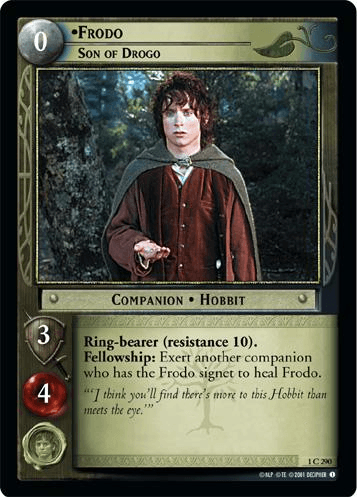
The LotR TCG was published by Decipher from 2001 to 2007. The game tied into the movies releasing concurrently, primarily using screencaps from those films for card art, but it also included characters and concepts that were only in the books.
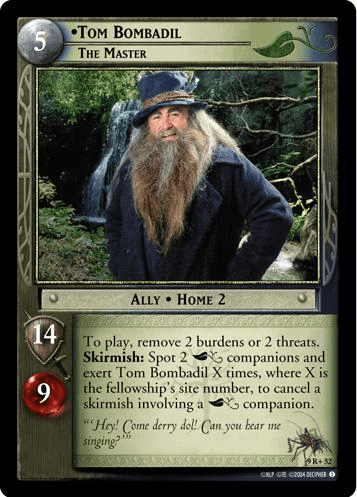
At the time, this was a popular game among many members of our California Redemption playgroup.
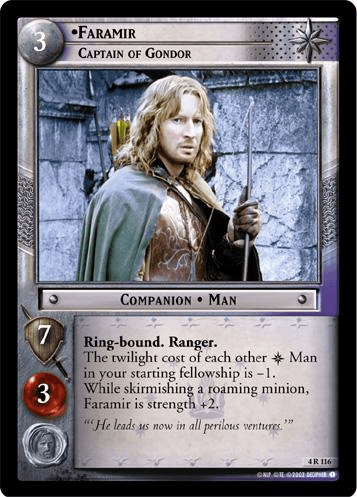
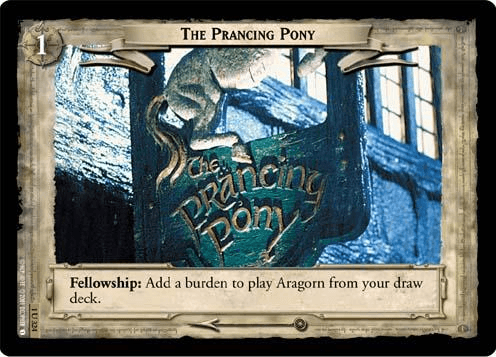
The LotR TCG actually has some major mechanical similarities to Redemption, beyond the basics that most games have in common. The most notable is that every LotR deck includes both good cards and evil cards; just like in Redemption, you use good cards during your turn as offense, and evil cards during opponents’ turns as defense. I’m not aware of any other card games like this. Most games have no distinction between good and evil, or if they do you just choose one to play as. Redemption and LotR are unique in that everyone plays both sides of the story, keeping their good and evil in play separately.
In addition, both games can be won by winning a “race” with your heroes (rescuing 5 souls in Redemption, or traversing the site path to Mordor in LotR) rather than by dealing damage to players like in MTG and its clones. I appreciate when games have unique, thematic objectives like this.
But these are obviously not the mechanics that influenced Redemption, because Redemption predates the LotR game. The Redemption mechanic inspired by the LotR TCG is weapons.
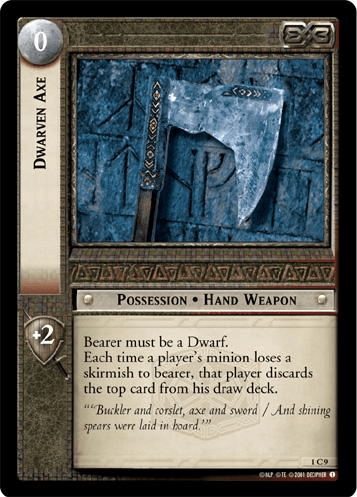
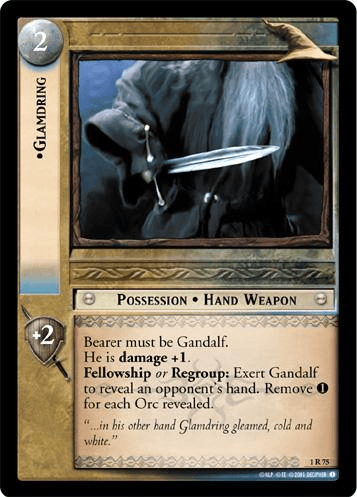
In the LotR TCG, possessions (most commonly “hand weapons”) are equipped directly to eligible characters, granting them increased numbers and/or an additional special ability. For example, you might equip a Dwarven Axe to Gimli. Some weapons can only be played on a specific character, such as Glamdring on Gandalf.
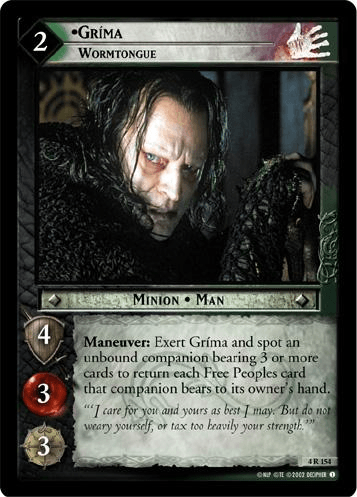
Evil characters (called “minions”) have their own weapons as well.
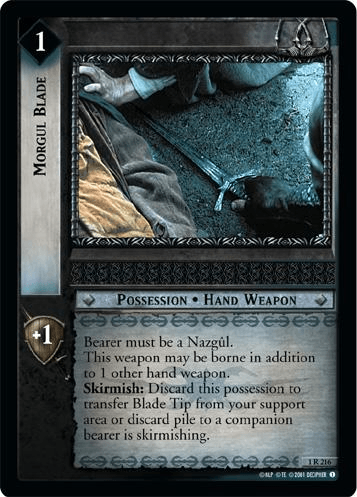
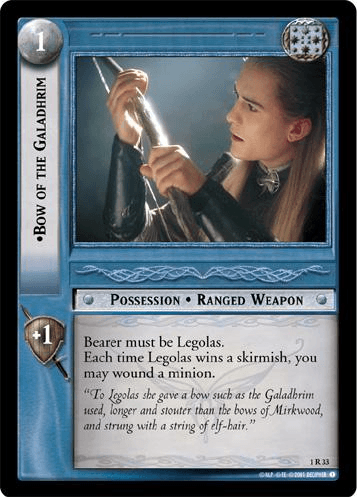
In addition to hand weapons, there are ranged weapons.
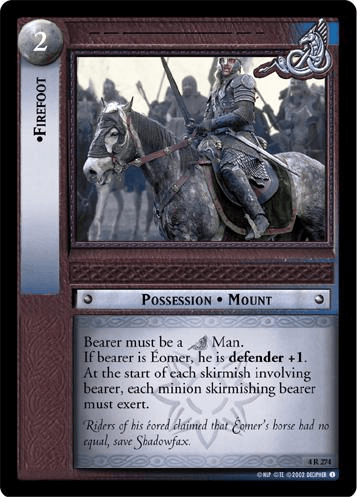
There are several more types of possessions, including mounts, which are similar to the various horses/chariots we have as weapons in Redemption.
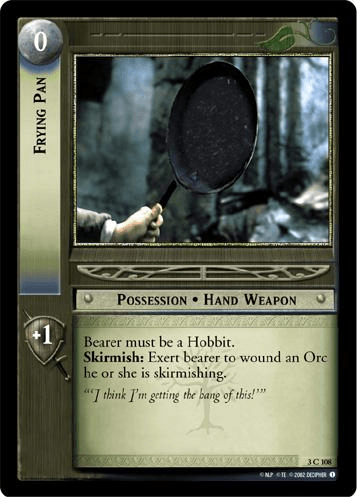
Believe it or not, the best weapon in the game was Frying Pan. It was so overpowered that it had to be banned.
Anyway, while this LotR game was still in print, my dad was a big fan. When he compared LotR’s possessions to the Redemption enhancements that represented weapons, he found the enhancements underwhelming. It was fun to equip your LotR characters with weapons that would remain on them, so he thought that weapons ought to work the same way in Redemption.
He and Mike Berkenpas both pushed for the mechanic to be added to Redemption. Thus, warrior class and weapon class were finally introduced in the Kings set. Kings included weapon class reprints of many old enhancements, as well as some entirely new ones. Weapons have been a part of Redemption ever since.
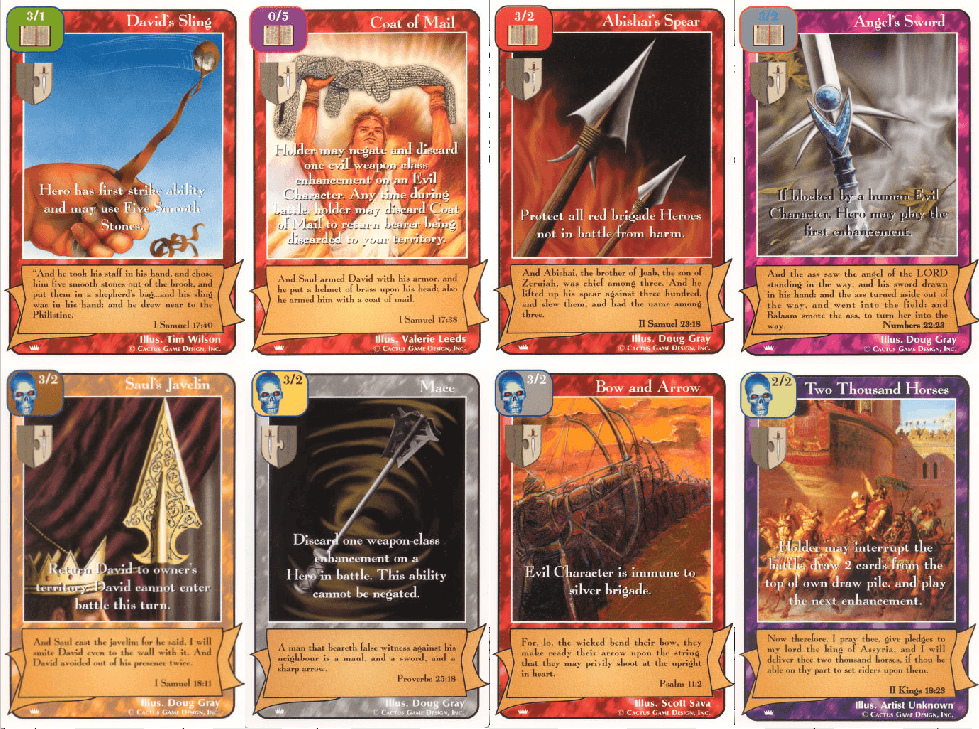
Of course, many card games include some sort of similar mechanic, whether it is called weapons, possessions, equipment, attachments, or upgrades. But it was LotR’s version of the concept that inspired Redemption’s.
Things That Are: LotR References in Cards
When I got back into Redemption last year, one of the many things that I appreciated about Israel’s Inheritance (the newest set at the time) was that it included some Lord of the Rings references.
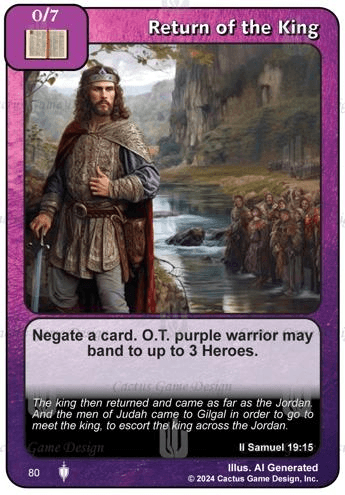
The most obvious one is Return of the King, which is the title of the final book of the trilogy.
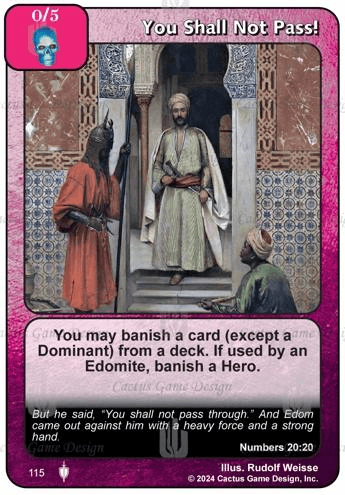
There is also You Shall Not Pass!, which is a Gandalf quote popularized by the films.
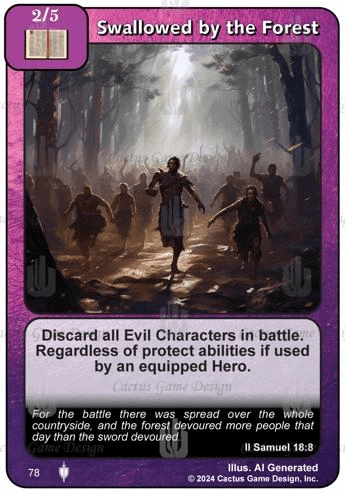
Although not a direct reference (and I assume unintentional), Swallowed by the Forest also makes me think of Lord of the Rings. It calls to mind the ending of The Battle of the Hornburg.
These LotR references are fun, but I especially appreciate that they were incorporated thoughtfully; they feel at home in Redemption and don’t overshadow the biblical concepts that they represent. The cards come across as simple homages to a wholesome book series, rather than desperate attempts to appeal to pop culture. Redemption is a Bible game, and I wouldn’t want it do devolve into something generic or nonsensical by shoehorning in various IPs without care.
Interestingly, MTG is currently facing controversy for making that mistake. I’ve never been a MTG player, but I know that some are upset that a game that once had a distinct theme now has cards from countless IPs including Jurassic Park, Transformers, Spongebob, and Spider-Man.
With all that said, it can be fun for a fan like me to imagine what actual LotR Redemption cards would look like. In honor of Hobbit Day, I’ve designed some custom cards. The first is almost biblical, but the rest are less so.
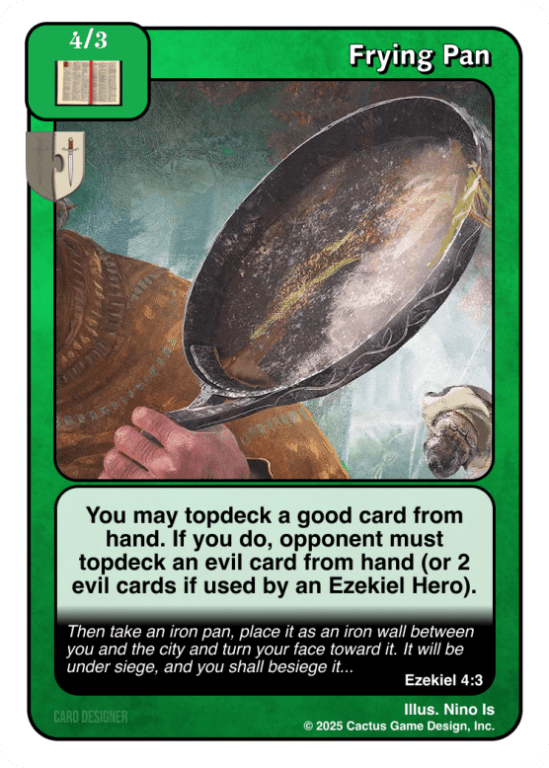
I made Frying Pan a weapon to resemble its banned counterpart from the LotR TCG. Although its art and it being a weapon are both nods to LotR, it would actually fit mechanically in an Ezekiel deck. You could equip it to The Watchman, and then have your Ezekiel, Sign from God band to him. That version of Ezekiel can already topdeck an evil card from opponent’s hand, so if Ezekiel’s ability is followed up with Frying Pan, opponent is topdecking a total of 3, and is unlikely to have enough evil cards left to block.
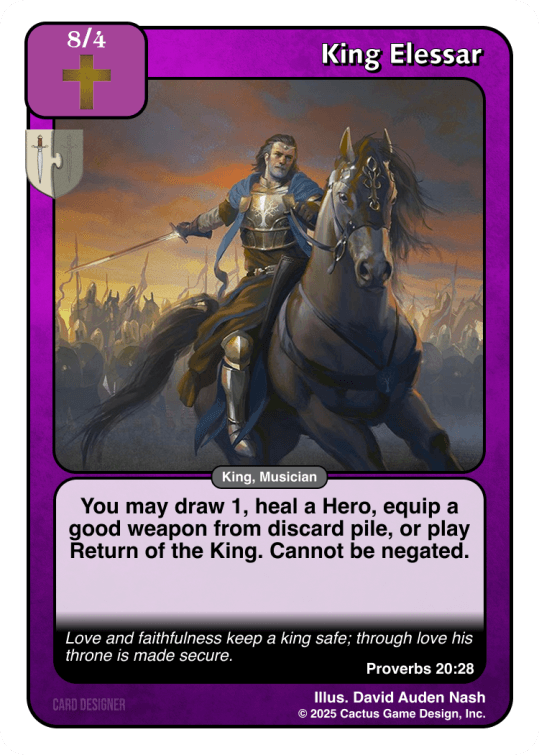
Aragorn is resourceful; he has the hands of a healer, wields the reforged sword Anduril, and unites the men of the West under his banner as the returned king.
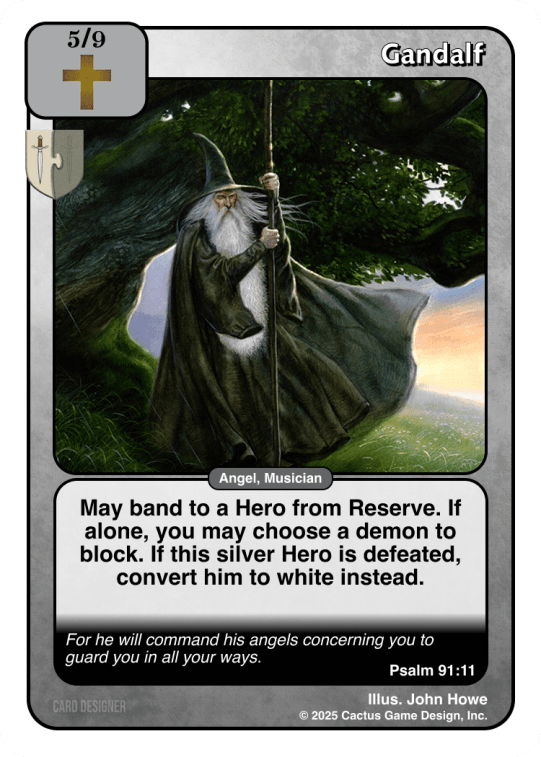
Gandalf the Grey is sent to inspire and encourage the free peoples against the enemy, but if faced with a demon of shadow and flame, he will deal with the foe himself. If he falls, he will be sent back as Gandalf the White.
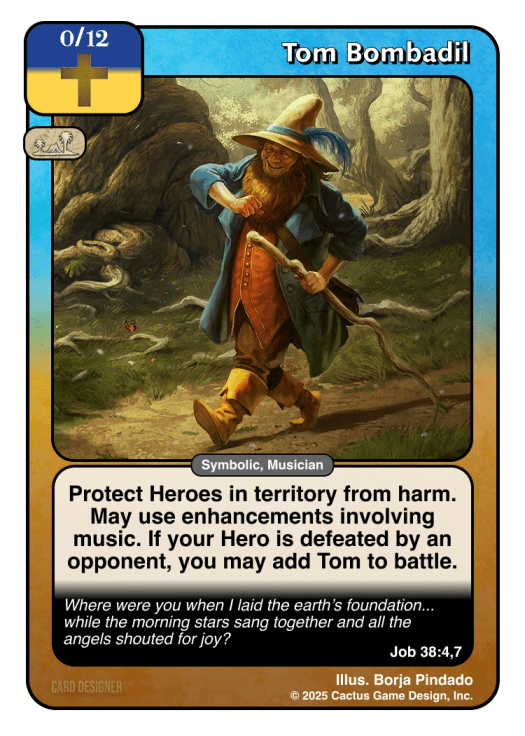
Old Tom Bombadil is a merry fellow; bright blue his jacket is, and his boots are yellow.
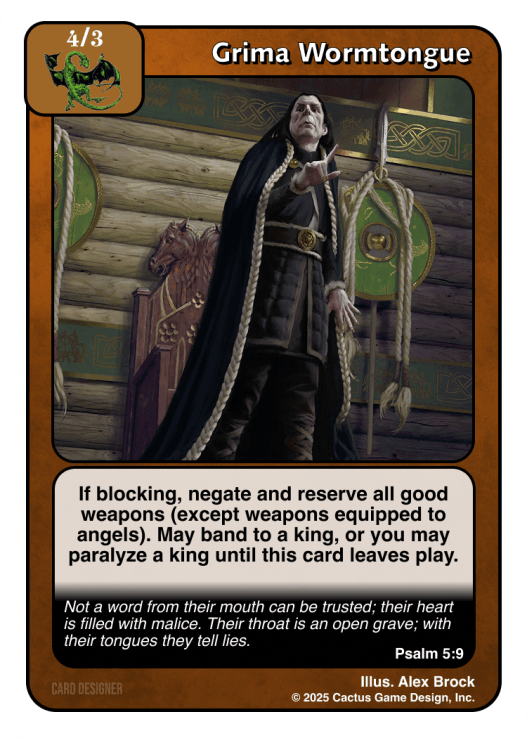
Wormtongue will confiscate your weapons and manipulate the king.
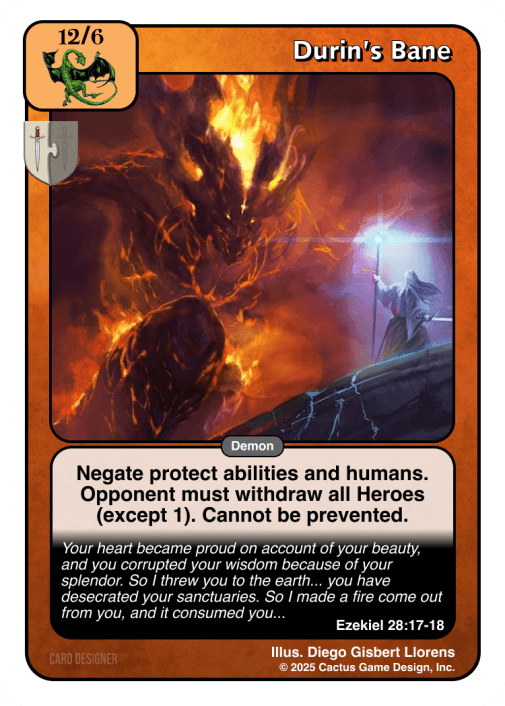
The Balrog is a foe beyond any of your heroes, except perhaps your greatest one.
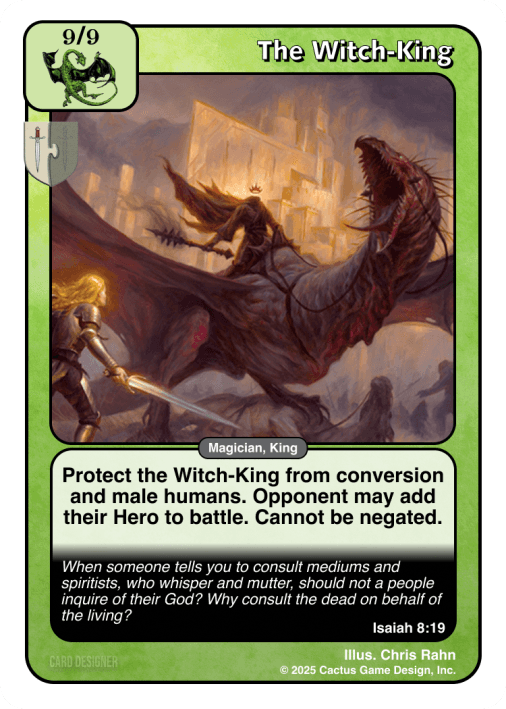
No living man may hinder the Witch-King.
I hope you enjoyed these customs. If you’d like to make some of your own, check out the card creation prompt at the end of this article.
Things That Yet May Be: Joppa
Last week, inspired by the discussion of Simon the Tanner, I challenged readers to design any card related to Joppa.
BaboonyTim decided to create a fortress card to represent the city:
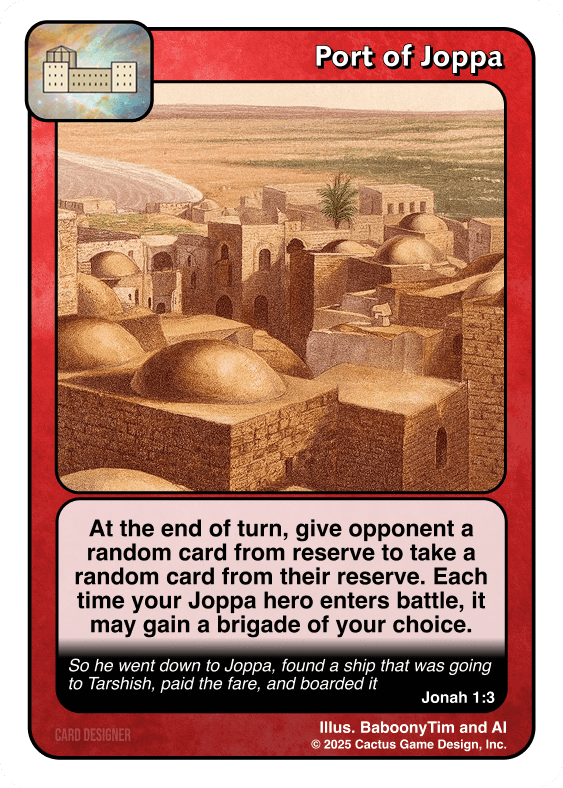
Joppa was a port city (in fact the primary port for Jerusalem), which Tim has represented with a fun ability that causes players to trade the cards they have in their reserves. The traded cards are taken to hand, so they can be immediately useful. Although the trading is random, there would still be interesting potential for first manipulating opponent’s reserve via cards like Teaching in Parables. I think this would be especially effective when paired with defenses like Persians (who have many abilities that manipulate opponent’s reserve) and Thieves (who love to play opponents’ cards).
I appreciate that this first effect does not specifically require any one theme, as Joppa played a role in events throughout the Bible. For example, supplies for Solomon’s Temple and the building projects of Ezra and Nehemiah were brought into Joppa’s port. It is also where Jonah boarded a ship to try to avoid going to Nineveh. In the New Testament, as mentioned last week, Joppa was where Simon the Tanner lived (perhaps taking advantage of the port for his trade). Peter stayed with this Simon while he was ministering in Joppa.
But the second effect on the card requires Joppa heroes, which is great because that church does not have any Redemption cards that support it in particular, like how the Philippi church has Letter to the Philippians. This ability is to grant Joppa heroes additional brigades. Mechanically, this calls back to Simon the Tanner’s ability. It also helps Joppa heroes play any off-brigade enhancements taken from opponent’s reserve, which ties it into the first ability quite nicely.
Fun design, Tim! Thanks for sending it in.
Card Creation Prompt
If you would like to create one or more cards for the next article, the challenge this time is to design a new card themed around the Lord of the Rings (or another Middle-Earth story). These can be biblical cards that merely reference LotR like the official You Shall Not Pass! and Return of the King, or fully-LotR dream cards like the examples I made above.
Please submit any cards you make to me (Ear-A-Corn on Discord) by the end of Saturday, 10/3. That’s in two weeks rather than one, because I’m skipping a week to free up more time for a special Redemption project I am developing for the community. Stay tuned for that!
Farewell, and may the blessing of Elves and Men and all Free Folk go with you. May the stars shine upon your faces!
To buy singles, sealed product, and other gaming supplies mentioned, please visit our sponsors!