Last year, after getting second in type 2 2 player, I decided I would play type 1 next year with the goal of winning. I thought I had a great shot at doing well this year in Nationals, but I was not able to make a tournament since last Nationals and I only got one game in on Wednesday. I was unsure what my expectations should be for someone who could not go to tournaments and adequately prep. I used not being at tournaments as my advantage. I built a deck in secret (yes, the guy who shares all his decks made a secret deck). I studied the meta tirelessly. The majority of my time was spent studying the meta via videos, LGP and tournament placings and deck lists. I felt I had a great grasp on the meta and was pleased in my “scouting report”. I think my secrecy paid off, as no one knew what I was on and no one knew to prepare for certain cards in my deck. I’m ecstatic that I won and accomplished my goal. I’m excited to see how the meta shapes up next year and I hope to contribute to the deck building!
I spent a lot of time prepping for Nationals, but leading up to the tournament I prayed that I would not make Redemption an idol and that I would do my best to glorify God and show love to others, regardless of the outcome. Whether I lost every game or won, I wanted to make sure I thanked God for the opportunity to play and see everyone. I didn’t get to talk to as many people as I wanted to, but I enjoyed seeing everyone and hoped I showed love and humility all weekend.
Before I start on my wonky deck decisions, I would love to thank a handful of people.
John Earley for tackling card images for Israel’s Inheritance. Gabe Isbell for his mentorship the last few years from themes to abilities to overall design. He continues to pour knowledge into me sharing what he has learned over his amazing career in Redemption. Marcus Parker for his dedication to rulings and maintaining the standard of our wording for abilities. Chris Fachman for working with me on Israel’s Inheritance and figuring out the themes and helping with abilities. Joe Schaefer for card input, making sure we as elders are rooted in The Word and reviewing each card in the set. For Roy Cruz for his love for the game and consistent sacrifice of hosting and teaching the game.
I want to thank Chad Franz, Joe Schaefer, Jay Chambers, Jeremy Chambers, Micah Rex, Brayden, Jayden Alstad, Dario Villanova, Maxwell from Minnesota, Mitch Stewart, John Hendrix, Robin Dermo & Joe Roberts. These players helped me make deck decisions, dissected the meta with me, shared deck lists, and helped me playtest potential Nationals deck choices or helped me get to the point of my final Nationals list. And also Brian Jones, because without him beating Jayden in the last round (sorry, Jayden), I would not have won.
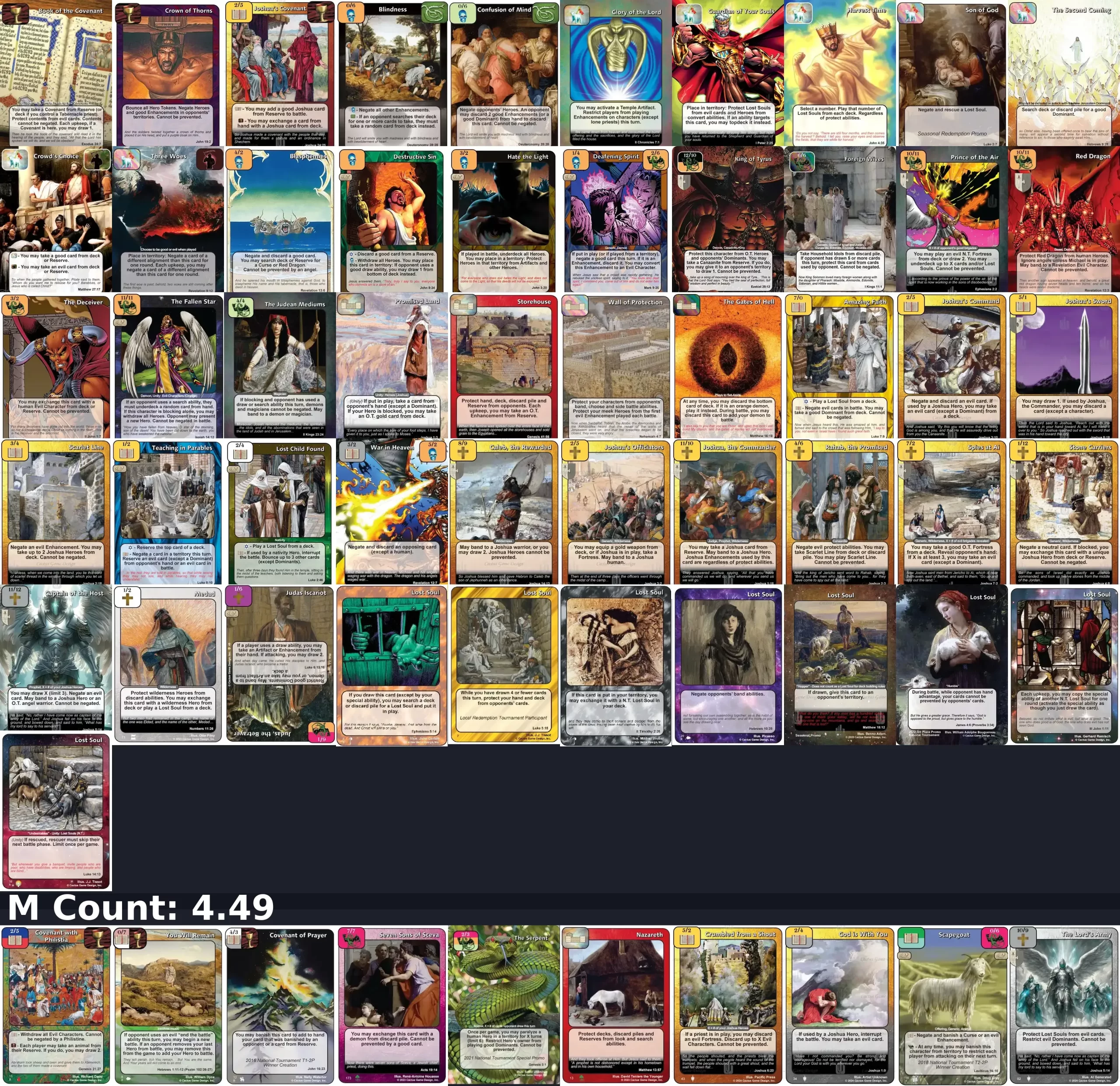
I have been asked a lot of questions about my build and why I chose not to incorporate commonly used Joshua cards. I’ll break down the deck by section with my reasoning for each card.
First section, Lost Souls
Throughout playtesting and montioring LGP results, studying deck lists and watching BaboonyTim and Redemption with Jayden videos, I quickly came to the discovery that there is very little that can successfully block Mary, the Restored due to the new duration ruling.
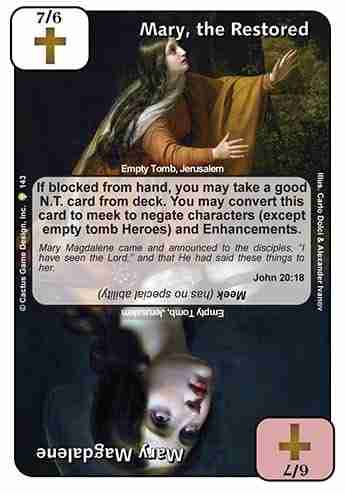
Meaning if I block with Prince of the Air and underdeck her, Mary can still get Harvest Time or Three Woes. I spent countless hours trying to find defensive cards that could stop Mary. I ultimately came to the conclusion that statistically, it would not be worth trying to stop Mary, but instead to just give my opponent a Redeemed Soul. If I am going to just give my opponent a Redeemed Soul I want it to be the most impactful Lost Soul I can think of. Undesirables has entered the chat. With this card I can let my opponent redeem it and buy myself another turn. With so many fast, consistent and aggressive offenses I thought just giving my opponent Undesirables for an extra turn for me was the smartest play. This means Gospel offenses cannot get all their Heroes in battle and Joshua can’t draw a lot of cards, plus any searching means more cards down on the table which is good for me.
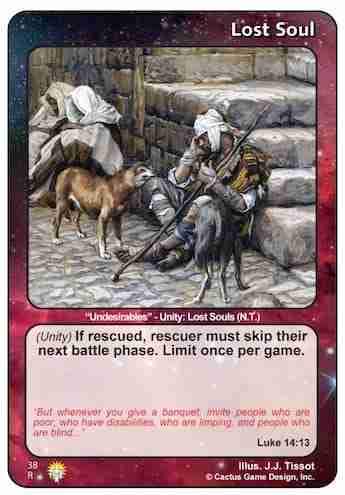
If my goal was to give away Undesirables turn 1 when I could not block I had to make sure I could get to Undesirables in my opening hand. This also meant I had to use all N.T. Lost Souls since Undesirables is N.T. unity. Awake and Escape are perfect for maintaining unity and getting out Undesirables. Awake also gave me a way to generate a Lost Soul from my opponent’s deck. Imitate allows me to copy a N.T. Lost Soul, so I could copy Imitate and generate a Lost Soul when I needed, which was extremely valuable. Forsaken is amazing. It prevents Entertaining Angels, The Child is Born and nearly all of Joshua’s Heroes (unless they start the band with Caleb). I also have the potential to draw into Forsaken when blocking for a negate after a band. Crowds is pretty obvious. It stops a lot of Joshua cards, hand looking and Matthew. Humble is also pretty obvious. I chose not to use Lawless as I felt the other Lost Souls were more impactful to the meta and helped me with overall value in ten rounds. Lawless does help with getting Undesirables and I can imitate it, but I could not justify that over other Lost Souls. Forsaken is too strong right now.
Second section, Dominants
My Dominant selection might be the craziest selection since John Earley’s in 2015 (I think?), where he did not use Son of God. My only battle Dominant was Glory of the Lord. Son of God and The Second Coming are obvious inclusions, but omitting battle Dominants that are constantly linked to Joshua was a crazy theory. Originally, the list had Grapes of Wrath. My deck has so many strong counters, consistency and speed, that I felt Grapes would not always help, plus I stop the I Am He bands a lot, so Grapes wasn’t crucial for me. I swapped it for Crowd’s Choice to help with consistency and another way to get Nazareth from Reserve. I think that decision was a huge contributor to winning. Guardian of Your Souls was obvious to me.
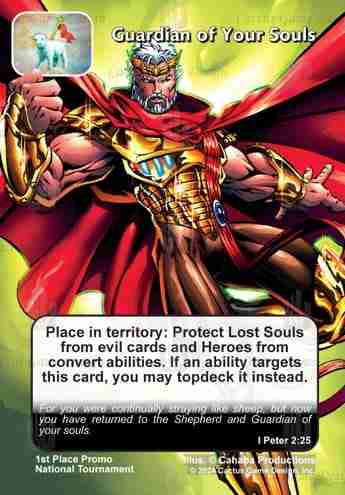
Big Clay was running rampant in tournaments. Prince of the Air seemingly couldn’t be stopped and I can’t allow hiding souls to happen, especially when Joshua has weak soul generation. Women of Thebez is included in a lot of decks. Small, aggressive clay decks are very strong and use Prince of the Air as well. Joshua is susceptible to soul protection chump blocks. Soul hide is always good. The list goes on. When I looked at the field of players and their tactics, GoyS was an obvious choice. Harvest Time aligns with the previous reasons I gave for GoyS, but if my opponent got off an early Harvest Time + Burial combo, I would not be able to attack, even with Imitate + Awake, as my neutrals tend to be negated. I needed a massive soul generation card for post Burial that also worked for my Lost Souls (playing Harvest Time turn 1 and giving them Undesirables or playing into a Forsaken to negate a band), and HT lets me be aggressive in my attacks. I consistently say you cannot be soul droughted at Nationals for any format. When it’s constructed you better have 3 or more ways to generate a Lost Soul and those 3 ways should all be different (aka not all neutrals). Hopper, Imitate + Awake, 2 * abilities and Harvest Time was plenty for me to never worry about soul drought, especially when layered with GoyS. Glory is an obvious add to this deck. Big banding offense that stops Dominants and protection on evil. Three Woes almost came out, but it’s too good and versatile.
Next section, support cards
Another section with some wonkiness. I decided negate neutrals would not impact my deck. Undesirables turn 1 is hard for negate neutrals to deal with and my Curses/Covenant and Artifacts all have modifiers. Book of the Covenant can be negated, but the Covenants active cannot be. Confusion of Mind is cannot be negated and Crown of Thorns (what’s that do?), is cannot be prevented. Crown of Thorns really messed up opponent’s.
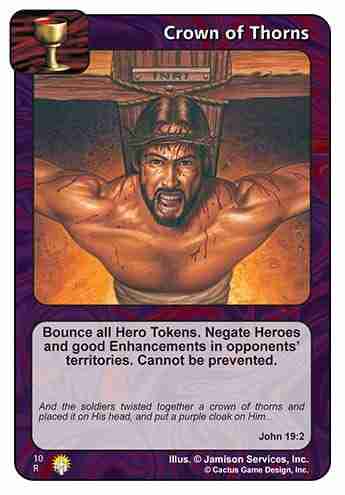
Against Joshua it stops their Lost Child Found, Teaching in Parables and any other TCE search card. Against disciples it stops a lot of searching and I Am He. Crown stops a lot of Nativity TCE’s as well. It also negates their Heroes in territory with CBP, meaning it stops their negate neutral Heroes. It also can bounce Hero tokens, which I didn’t think was relevant, but Jeremy played Impartial Judgment, although Crown was not needed in that game. Confusion of Mind negating only my opponent’s Heroes with CBN is brutal. Most decks play hand protection, so the opponent can’t pay the cost on CoM. Negating Heroes really shuts down a lot of what clay strives to do. Most Gospel of Christ Heroes are not CBN or CBP, particularly the strong battle Heroes. CoM is another counter to negate neutrals as well. Between Crown and CoM I should quickly be able to get out from negate neutrals while negating all their Heroes or stopping their good TCE’s.
Promised Land is an obvious choice for Joshua and Gates of Hell for demons. Although Joshua has great Reserve access, I wanted to include Storehouse for a few reasons. First, this Storehouse is from Israel’s Rebellion and it protects my discard pile (Gabe’s idea to differentiate them slightly and it paid off big time). I was worried about Husham and Jayden banishing my discard pile, so I wanted SH. I also wanted more ways to get Scapegoat and You Will Remain if my Book of the Covenant is gone. Wall of Protection was card 51. I wanted 50, but I needed WoP. There’s too many Judean Mediums and Joshua offenses running around, plus I expected to see choose the blocker from clay. WoP worked extremely well and stopped a lot of the CtB.
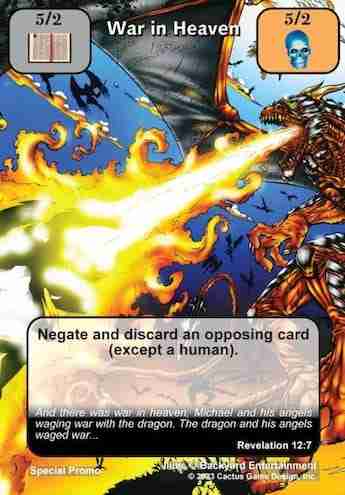
One of the MVP’s was War in Heaven. Prince of the Air loves to block two brigade bands because they can underdeck potentially one brigade leaving a vulnerable Hero out that has no support. God is With You in Reserve helps, but I wanted something I could use for offense and defense. War in Heaven was perfect. It can negate and discard Prince, or any non-human in battle, or discard an angel in battle. It also gives me an additional Enhancement to toss if I go against Herod’s Temple or a toss Hero. I can toss an EE and then play War in Heaven, or toss War in Heaven.
Next section, Heroes
More wonky decisions! I ran Book of the Covenant and did not run clay priests, crazy! With Prince of the Air causing mayhem, I decided to bring down my good brigade count. Between Joshua’s Covenant, Crowd’s Choice and Scarlet Line, I can get out who I need. Joshua’s Covenant and Crowd’s Choice also enabled me to drop my Hero count to 8 while still having Heroes in my opening hand. Medad always goes back to the deck or stays in hand. Unless they Twenty Shekels him (I have Crowds and Storehouse for layered hand protection and I can Imitate Crowds for triple hand protection), I figured Medad was safe in my hand. That left me with gold and silver for 2 good brigades. My Joshua band gets to 5 Heroes and I layer my Lost Soul protection, so Prince of the Air didn’t bother me any.
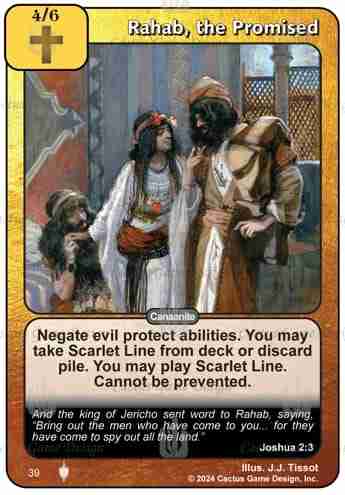
Most decks don’t run gold Rahab. With so many defenses not blocking turn 1, or simply can’t block due to Promised Land and Teaching in Parables, plus Woman of Thebez being a popular turn 1 block, Rahab was an auto-include. Getting to Scarlet Line to thin your deck 1, then playing it pre-block to take 2 Joshua Heroes for a huge turn 2 value and attack is too good not to use. Also, you have to generate value each turn. Rahab means you can just play Scarlet Line and thin your deck 3 cards, set up turn 2 and get value from the attack when otherwise they would not have blocked. The recur is also nice against Jayden for a CBN negate against his CBP EE’s. Spies at Ai is pretty normal and I used him for the mirror. Stone Carriers, Joshua, Joshua’s Officiators and Captain are all auto-includes. Caleb is in most decks, but sometimes he is in the Reserve or not in the deck. A previous version I ran Holy of Holies, so Caleb was awesome, but I dropped that card. Confusion of Mind is good, but I was mostly worried about Forsaken and Accusers. Caleb stops all of that and adds another Hero to my band to limit Prince of the Air’s potential to block, or gets me a potential draw 5 with Captain (another Joshua Hero) and band to Caleb. A draw 5 without looking at their hand or having to bounce is huge! I’m looking at you Matthew. Medad in main deck helped me get Joshua or Stone Carriers turn 1 and Stone Carriers can turn into Rahab or Captain. Medad also lets me get Officiators to band to Joshua. I then have Medad for Lost Child Found whenever I get them both.
Next section, good Enhancements
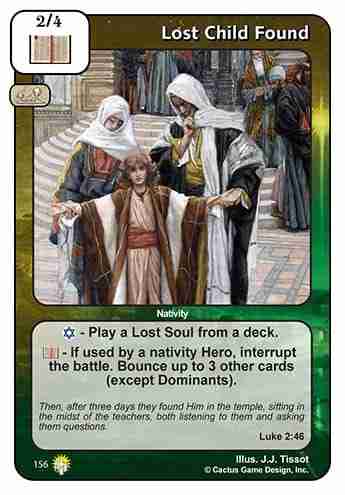
Most of my selection was pretty normal, except my inclusion of Lost Child Found. Having another * ability to play Undesirables is ultimately why this card came into the main deck. I still think Joshua is the fastest deck in the game that does not rely on the opponent. Joshua’s Officiators to equip Joshua with Joshua’s Sword from deck and band to Joshua who gets a card from Reserve, draws 1, bands to Captain to draw 3 and bands to Caleb is 8 cards and -1 for your opponent. That’s a +9 net. Every turn you get a +9 net (you lose Joshua’s Sword from deck, but you can take their Fortress) if you want, or just swap to Lord’s Army for a strong attack. I explained Scarlet Line in my Hero section. Amazing Faith to play a Lost Soul is soul generation or a way to Undesirables turn 1, plus another way to Harvest Time or GoyS. Teaching in Parables is usually a battle winner. I love Joshua’s Command, it’s probably my favorite card from Israel’s Inheritance. The negate and discard coupled with taking an evil card from any deck is just too good. Getting to a blocker or Hate the Light is so strong, or you just take their best defensive card from their deck. Lost Child Found I got the most questions on and I have explained the reasoning already, but the additional benefit for an early double Promised Land is so good. Also, BotC can discarded or negated and if I don’t get to New Covenant I don’t get to Lost Child Found. Speaking of New Covenant, that’s another card that is typically in Joshua decks. I traditionally don’t play heavy support in type 1 decks as I tend to dedicate those spots to defensive resources. Because I have 4 Fortresses in this build I had to limit my Artifacts. I also only played CBP/N Artifacts, which New Covenant works on BotC, but ultimately, I want CoM or Crown of Thorns active and not BotC. I will dive into the Reserve choices later in this article, but my Reserve is precise and I didn’t have a spot for New Covenant, not would I have the time to get it. More on that later.
Next section, Evil Characters
I have the reputation in type 1 for playing and making strong defenses. I hope I maintained that reputation at Nationals. I think playing defense in Redemption is becoming a lost art and I hope this deck helps the community create strong defenses and believe they work.
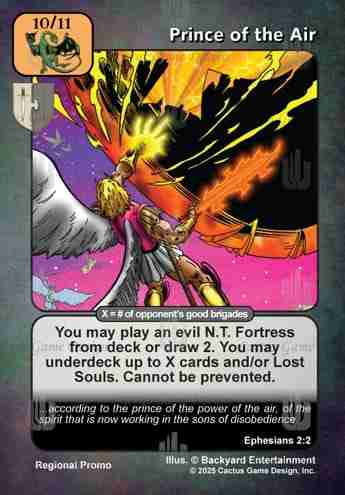
I made numerous defenses leading up to Nationals. All of them were centered around stopping Mary the Restored turn 1. I had a few good options, but nothing felt cohesive (thank you Chad!). I didn’t like wanting to block with Prince of the Air and not having support for him, so I decided to go (mostly) all orange. As strong as Prince of the Air is, he’s got the biggest bullseye on his back. I wanted other targets for Judean Mediums plus strong Evil Characters for Gates of Hell to bring in. Letting the opponent use their Love One Another or negate, then adding in a Red Dragon is very strong. King of Tyrus is great against Joshua, as I tend to just out-negate my opponent’s good Enhancements and Joshua’s regardless of protect us no longer an issue. Against GoC offenses, KoT is still protected from their Dominants, so he has merit still. The Deceiver to get to Judas, Foreign Wives, The Judean Mediums and Seven Sons of Sceva in Reserve was a last minute swap over Messenger of Satan, thank you Joe! Judas is key to this defense. Restricting good Dominants is very strong, especially when top players rely on battle Dominants. Have Forsaken down and block with Judas and a lot of decks just can’t get around a Judas to Prince or Red Dragon. He also is another target when my opponent doesn’t draw or search I substitute Judas for Judean, or just having both options available to use is strong. Foreign Wives in main deck has been a fun debate due to Matthew. Ultimately, I think Matthew loses to Foreign Wives, even if they get a large draw. The Deceiver to Foreign Wives in deck after a small draw is also very strong. Fallen Star is usually an auto-include for all orange. It’s another piece of the defensive layer and overall control aspect of the deck. He’s especially strong when Joshua is blowing up the opponent’s hand protection Fortresses. I don’t think Prince of the Air needs further explanation, but giving him a lot of support only makes him stronger and he allows me to underdeck Possessing Spirit (which I had to do against Jeremy), and underdeck my own Promised Land to play again.
Next section, evil Enhancements
Time for some real wonkiness! Evil Enhancements are still good, but I do agree with Tim that they’re tough to play, especially when you give them no other support. Judas, putting the opponent in special initiative, Confusion of Mind and adding to battle are all ways to leverage evil Enhancements.
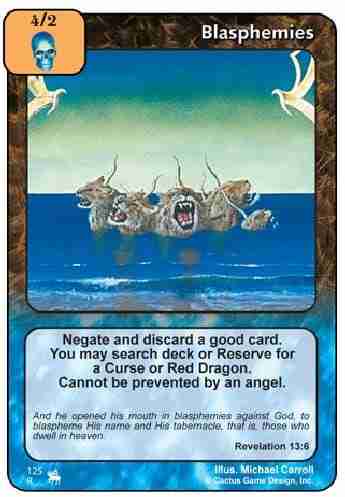
I wanted negates as I tend to block with Prince or protected Evil Characters, but I also wanted value. Blasphemies allowed me to get to Blindness, Red Dragon or Confusion of Mind and gave me a broad negate and discard. I needed the negate and discard to discard a strong Hero usually, as I don’t get rid of Heroes permanently, Prince of the Air usually underdecks them and I discard their key Hero.
Since EE’s need a lot of support, my thought process was what EE’s could I use that I don’t need to play in battle, yet still impact my opponent? Hate the Light and Destructive Sin are amazing cards.
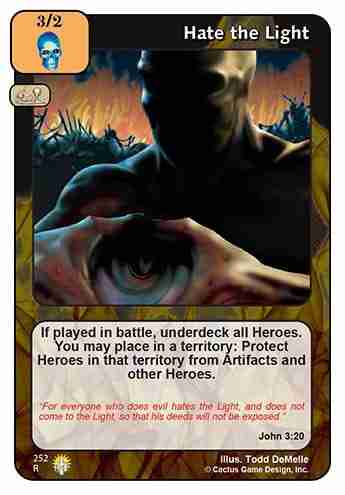
Most of my opponent’s, including the top players, had to read Hate the Light and consistently walked into trying to band to Heroes that were down, not able to exchange to Heroes down, or bounce their Heroes with Artifacts. Jeremy played it very well, even informing me that his tokens would have been protected from Crown of Thorns with Hate the Light, I didn’t realize that, touché Jeremy! With so many offenses trying to draw, search, play Heroes and band, Hate the Light consistently hindered opposing offenses and what they were trying to do. It was another defensive layer that forced the player to play outside of their comfort zone, which this deck tries to accomplish. Force the opponent into my playstyle and control what they can and can’t do. For the record, I would never play Hate the Light in battle unless it was absolutely necessary.
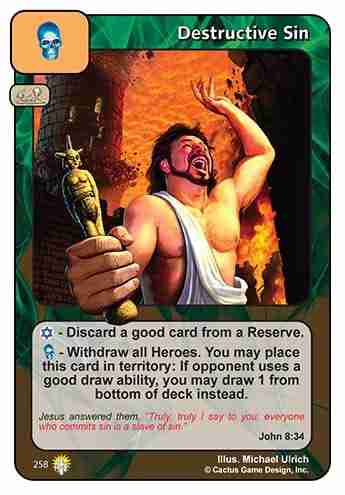
Destructive Sin I could play in battle, but was mostly to play early to slow down offenses. The * ability is also good, but getting an early Destructive Sin down can cripple offenses. Blindness was always used as an EE, but I could activate it early against people to stop their drawing. Getting Blindness from Blasphemies, having a broad negate for my EC’s and having the ability to play it early to stop searching (insanely strong when paired with Destructive Sin), made for a strong and flexible EE. Since I included Nazareth in the Reserve, I wanted to have ways to get around my Nazareth if needed. I also wanted an additional EV if needed. Deafening Spirit fixed those needs for a strong and flexible negate that is tough to negate after played. He’s also a Gospel EC if they choose Possessing Spirit without negating it I can band to have an additional EC in battle which is nice against Simon. With Blindness and War in Heaven I had a total of 6 EE’s, 3 of which I could play out of battle, 2 of which I could play out of battle and impact my opponent’s offense, 1 I could play on my offense, 1 I could activate to slow them down, 3 of which are battle winners and one can generate a blocker or Curse for me. The EE’s were calculated and extremely efficient.
Next and final section, the Reserve
A lot of this deck is contributed to Jayden playing Banishing Act. Banishing Act and Tim’s 100 card decks were the two decks that helped my decisions when crafting this deck. I knew I needed Covenant of Prayer (Gabe’s create a card after John made Confusion the year before) against Jayden, but what card would be good for Covenant of Prayer to grab against everyone else? Thus, Nazareth was included.
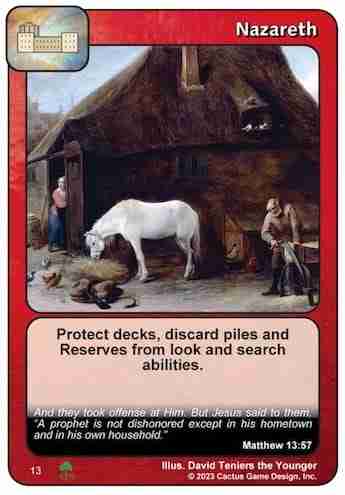
I did not think people would tech for Nazareth, not many would expect to see it. Between Joshua’s Sword and Crown of Thorns, once Nazareth is down I can make it extremely difficult to get rid of. When coupled with Teaching in Parables and Promised Land, Nazareth tends to become a rescue. PL/TiP to take/Reserve what’s needed, then Nazareth down to stop The Deceiver or Antipas plays.
I didn’t think I needed many Joshua cards in the Reserve, you can only get so many out per game. SH, Joshua and BotC all helped me get what’s needed. Cov Philistia was to get a +2 and snag Scapegoat (a card I made years ago and wanted to include partially for that reason). I wanted Scapegoat just in case my opponent had a strong start and I needed to buy time. Scapegoat and Undesirables gives me the ability to buy time and put down more control cards. Scapegoat in the last round is also an extremely strong play, which I used to ensure a timed win against Joe A. It lets you attack on your turn and they can’t attack on their turn and that’s game. The Serpent was for an additional draw 2 off Philistia and another Dominant stopper. You Will Remain is an obvious choice, as is God is With You. The Lord’s Army is the main reason I picked this offense. Protecting Lost Souls and restricting evil Dominants stops a lot of meta blocks. Crumbled from a Shout was also for Jayden since it’s CBP, but I needed a mass discard for Possessing Spirit and it’s good for tossing if needed. Seven Sons of Sceva was a late add that can in for Serpent’s Curse. It seemed pretty obvious due to my defense and got me a block one game.
Elements of the deck
When you combine Hate the Light, Destructive Sin, Confusion of Mind/Crown of Thorns, Nazareth, Forsaken, Undesirables/Scapegoat, The Fallen Star, Joshua’s Officiator’s and Joshua’s Sword, Teaching in Parables and Promised Land abuse, the opponent quickly runs out of options.
When I attack The Lord’s Army is nearly always in battle and when I block I have Gates of Hell down and block with Prince of the Air, or I have Judas in battle. Majority of the time I do not allow my opponent to play Dominants in battle.
The deck combines numerous elements that work well together that stifles the opponent’s plays and pushes them outside of their comfort zone. Lesser used cards also increase the chances of my opponent making misplays, which isn’t something to rely on, but does add another element to the deck.
I was blown away when Brian told me he beat Jayden in the last round. I had just barely gotten by Jeremy Chambers for locking up second place, then Brian told me he won which meant I got first. It was definitely a moment I will not forget. I hope this article answered all the questions you had for my deck and card selection while encouraging you to think outside the box, find ways to block, and always give glory to God!
To buy singles, sealed product, and other gaming supplies mentioned, please visit our sponsors!